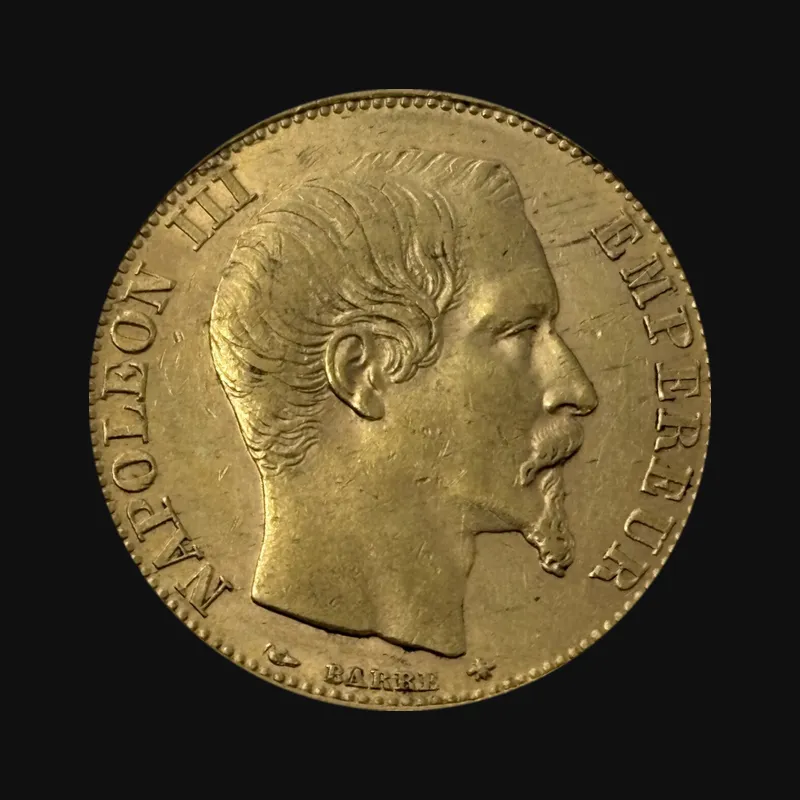
Obverse
Napoleon III in profile, facing right, without laurels, with short hair, a moustache and an imperial (goatee). Legend ‘NAPOLEON III EMPEREUR’. The signature BARRE is engraved below the truncation of the neck, between two tiny symbols.
Numismatique Grasse coin page, by Maison Or & Bijoux Mougins · reviewed
| Country | France |
|---|---|
| Metal | Gold 900/1000, i.e. 5.806 g of fine gold |
| Weight | 6.45 g |
| Diameter | 21 mm |
| Years struck | 1853 to 1860 |
| Mints | A (Paris), every year; BB (Strasbourg) in 1855, 1856, 1858, 1859 and 1860; D (Lyon) only once, in 1855 |
| Total mintage | 146,544,669 |
| References | Le Franc F.531 |
For the first eight years of the Second Empire, the gold 20 francs shows Napoleon III without a wreath. It is one of the most plentiful napoléons ever struck, with more than 146 million coins. Behind its ordinary look, though, lie a few dates and symbols that collectors examine closely.
Napoleon III in profile, facing right, without laurels, with short hair, a moustache and an imperial (goatee). Legend ‘NAPOLEON III EMPEREUR’. The signature BARRE is engraved below the truncation of the neck, between two tiny symbols.
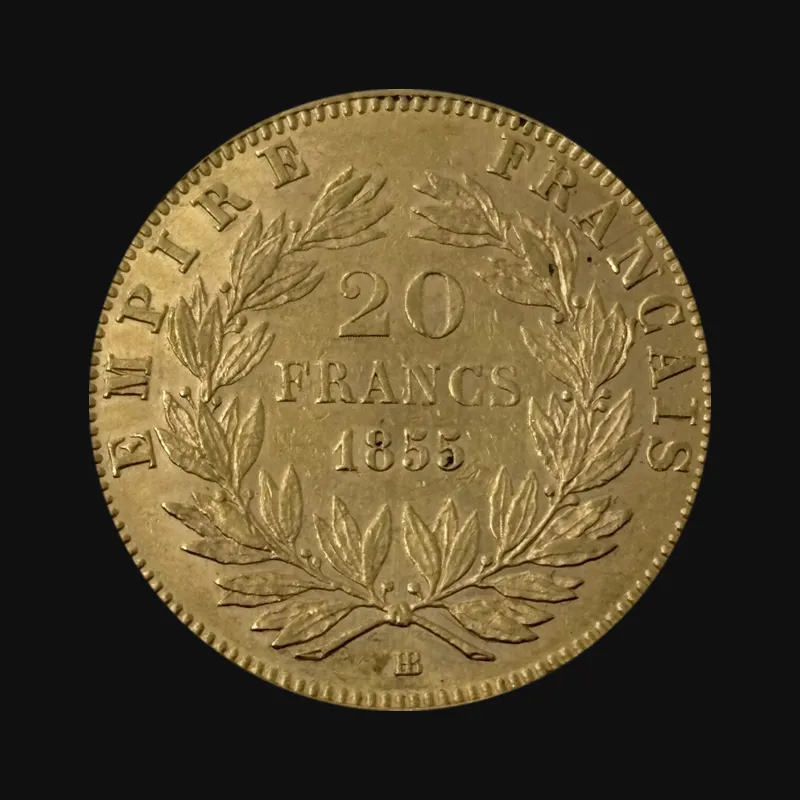
‘20 FRANCS’ and the date on three lines, inside two laurel branches tied with a ribbon. Around it, ‘EMPIRE FRANÇAIS’. Below the knot sits the mint letter: A, BB or D.
Fourteen combinations in all, every one of them listed here. Paris dominates each year with millions of coins. The dates to watch for are outside Paris: Lyon in 1855, then the early years of the BB mint.
| Year | Mint | Mintage | What to look for |
|---|---|---|---|
| 1853 | A | 5,729,471 | First year; burnished flan with plain edge |
| 1854 | A | 23,485,957 | Most plentiful year; burnished flan known |
| 1855 | A | 16,595,397 | Two pairs of symbols: dog and hand, or hand and anchor |
| 1855 | BB | 1,759,701 | Two pairs of symbols (bee with dog or with anchor); figure varies between sources |
| 1855 | D | 363,017 | Only Lyon issue; small or large lion, and D over A |
| 1856 | A | 17,302,537 | Common |
| 1856 | BB | 1,125,030 | Smallest BB mintage for this type |
| 1857 | A | 19,193,214 | Paris alone that year |
| 1858 | A | 16,860,982 | Common |
| 1858 | BB | 2,016,653 | Figure varies between sources |
| 1859 | A | 20,295,429 | Common |
| 1859 | BB | 5,870,646 | Largest year for the BB mint |
| 1860 | A | 10,219,917 | Variety with 6 recut over a 5 |
| 1860 | BB | 5,726,718 | Variety with 6 recut over a 5 |
Figures from BDOR and Abacor, which agree and add up to the total of 146,544,669. Other published figures: 1,817,394 for 1855 BB (Numista, CoinVarieties), 2,067,740 for 1858 BB according to CGB. Varieties within a single year are not counted separately; burnished flans have no known mintage.
First clue, the hair. No leaves, no ribbon: the hair is short and leaves the ear clear. If you see a laurel wreath, the coin is later than 1860 and belongs on the page for the laureate-head 20 francs.
Second clue, the reverse. There is no eagle and no shield, only the words ‘20 FRANCS’, the date and two laurel branches. This leafy design is what tells the two types of the reign apart most quickly, even from a distance.
Third clue, the obverse legend. It must end with ‘EMPEREUR’. An almost identical profile appears on the 1852 coin in the name of ‘LOUIS-NAPOLEON BONAPARTE’, struck during his presidency with a republican reverse.
Only then read the year and the letter below the ribbon knot. For a doubtful coin, the scale should show 6.45 g, give or take a few hundredths on a worn piece. Our French guide to reading a coin shows how to find each inscription.
Below the neck, on either side of the name BARRE, two tiny symbols identify the officials responsible for the striking. One belongs to the chief engraver. Until June 1855 it is a dog’s head, the mark of Jacques-Jean Barre. On his death, his son Albert-Désiré took over the post and replaced it with an anchor.
The other symbol belongs to the mint director: a hand for Paris, a bee for the BB mint, a lion for Lyon. In 1855 and 1856 you therefore find two versions of the same date. Paris moves from dog and hand to hand and anchor; the BB mint from dog and bee to bee and anchor. Coins with the dog’s head are the less numerous.
The reverse carries no symbol: only the letter counts. These details can only be read with a loupe, under light from the side, on a coin with little wear. On a heavily circulated piece, the dog’s head and the bee become mere dots.
The hardest date of the type is 1855 D. Lyon struck bare heads only in that year, 363,017 of them, in three varieties: a small lion, a large lion, and a letter D engraved over a Paris A.
Next comes 1856 BB, at just over a million coins. That is few compared with Paris’s seventeen million the same year. The 1855 BB, barely more plentiful, exists with both pairs of symbols described above.
Some 1860 coins, from both mints, have a corrected last digit: the loop of a 5 shows beneath the 6 under magnification.
Finally there are the burnished flans of 1853, 1854 and 1855, carefully struck and recognisable by their mirror fields and plain edge. A plain edge on an ordinary coin without mirror fields, on the other hand, should raise doubts. To look after them, see our French guide to storing coins.
The gold 10 francs of the same period repeats this portrait at a smaller size: 19 mm and 3.23 g. A coin that seems too small is not necessarily false; it may simply be a half napoléon.
The oldest forgeries date from the Second Empire itself. They are gilt platinum pieces, recorded for 1857 A, 1858 A and BB, and 1860 A and BB. The gilding wears off the high points and reveals a grey metal. Today they are kept as curiosities.
Recent counterfeits are more deceptive, as they are struck in gold. They give themselves away through soft hair, blurred or badly formed symbols and uneven edge lettering. Abacor also reports one-sided trial strikes in gilt bronze, easy to rule out on the scale.
On a genuine coin, wear first flattens the locks near the ear, then the cheekbone and the goatee; on the reverse, the veins of the leaves. A coin on which every lock remains distinct has seen little circulation. Do not rub it: cleaning scratches never go away.
The last year of the bare head is also the year the Grasse area changed department. Signed in Turin on 24 March 1860 and approved by the voters of Nice on 15 and 16 April, the treaty transferred the County of Nice to France. In June, Grasse and its surroundings left the Var department to form, with the former county, the Alpes-Maritimes. All the bare heads from 1853 to 1859 therefore predate this change.
Yes, provided the year is between 1853 and 1860 and the legend ends with ‘EMPEREUR’. An 1852 coin with the same profile bears the name of Louis-Napoléon Bonaparte: that is a different type.
No. Lyon struck them only in 1855. A bare head with the letter D and any other date should be examined closely.
Because the chief engraver changed in the middle of the year. The father signed with a dog’s head, the son with an anchor, and both marks are found on 1855 coins.
Bertrand Mathieu, numismatist at the Mougins shop, checks the mint, the symbols and the authenticity during a free assessment.