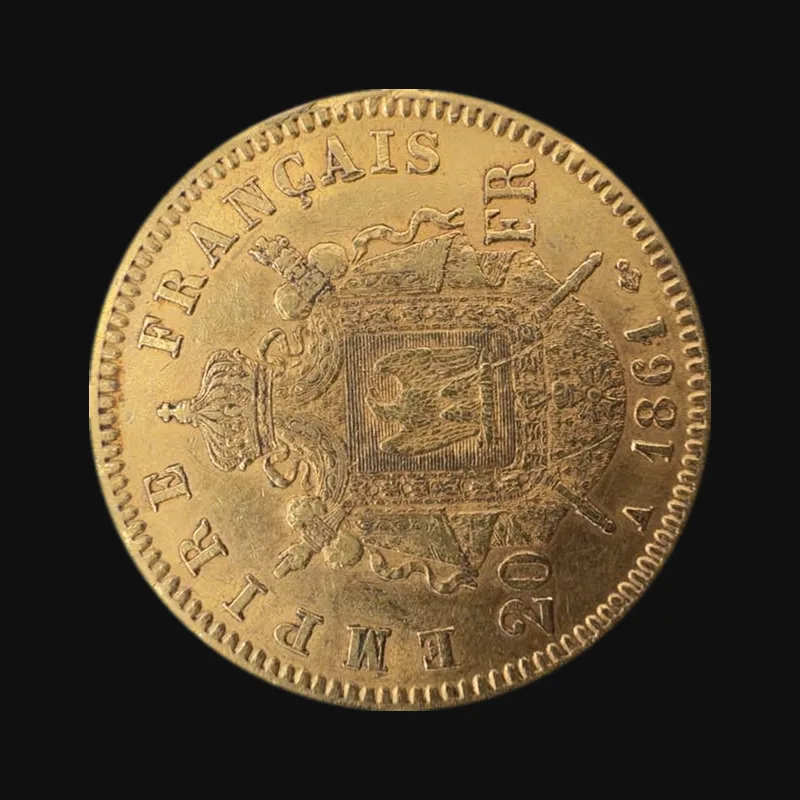
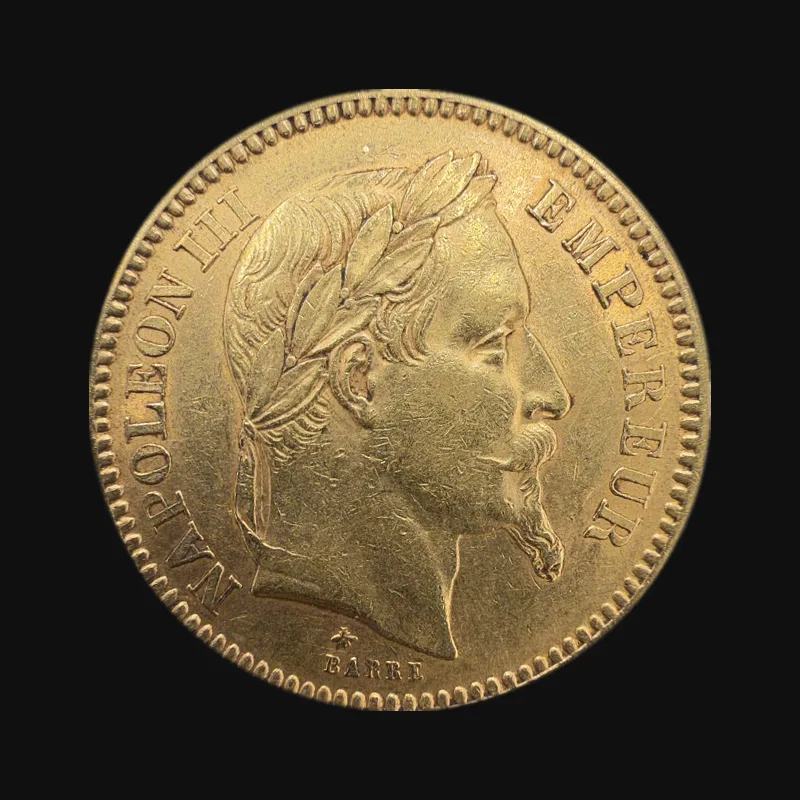
Laurel and eagle: the laureate head in three seconds
Look at the hair. A wreath of leaves, tied behind the head, and two ribbons on the nape: this is the laureate head. Without leaves, the coin is an earlier napoléon, described on the page for the bare-head 20 francs.
Then turn the coin over. The leafy wreath of the 1850s has gone; in its place is a large heraldic design: the eagle in its shield, the collar of the Legion of Honour, the imperial mantle and its crown. The figure 20 and the abbreviation FR are pushed out to the sides.
The new design was set by a law of July 1860 (the 18th), and striking began the following year. Weight and fineness stayed those of every napoléon since 1803. The presses stopped in September 1870, when the Empire fell.
All dates therefore run from 1861 to 1870. A laureate head dated outside those years should be checked. Our French guide to reading a coin explains how to decipher legends and dates.
A letter left of the date, a symbol to the right
On this type the mint is read on the reverse, at the foot of the shield: the letter sits just before the date. The letter A stands for Paris, the double BB for Strasbourg. Lyon, which had taken part in 1855, struck no laureate heads.
To the right of the date, look for a tiny design. The 1866 A coin in the Musée Carnavalet shows an anchor, the mark of Albert-Désiré Barre. On the obverse, above the name BARRE, the same specimen carries a bee: that of Alfred Renouard de Bussière, who ran the Paris mint from 1861. The two marks are thus split, one per side, whereas the bare head grouped them below the neck.
One detail requires a comparison coin: the height of the mint letter. Some 1862 Paris coins have a large A, and large BB letters are known for three Strasbourg years: 1864, 1867, 1869. Place two coins of the same date side by side and compare them under a loupe.
The dates that catch the eye
Among circulation coins, 1870 A comes first: fewer than 870,000 pieces, struck in a year of war. Next come 1861 BB, Strasbourg’s first year for this type, and 1870 BB, below two million.
The variety collectors look for most is the 1866 BB with reeded edge. Instead of the raised motto, the edge shows a series of ridges. Turn the coin in the light: the difference is visible without a loupe.
The large mint letters form a more accessible group. The large A of 1862 and the three large BB turn up more often, but remain less numerous than the ordinary coins of the same years.
Lastly, there are patterns (trial strikes) of the type, notably dated 1861 and 1862. They stayed in collections and almost never appear in an inheritance.
For all these coins, condition matters as much as date. A coin with little circulation keeps a satin lustre between the letters of the legend; see our French guide to storing coins so as not to damage it.
Platinum fakes, gold fakes and coins of the same size
The laureate napoléon was imitated as early as the Second Empire with gilt platinum pieces. The dates cited by Abacor and BDOR include 1865 BB, 1867 BB and 1868 A. Their weight can deceive, but wear reveals a dull grey beneath the gilding. These period forgeries now interest collectors in their own right.
Modern copies, often in gold, give themselves away through the design: muddled eagle feathers, blurred collar links, laurel leaves without veins, irregular edge lettering. Weigh, measure, and look at the eagle under a loupe.
Some foreign coins share its size and weight to the hundredth of a gram. These are the 20 francs or 20 lire of the Latin Monetary Union, the 19th-century currency agreement, struck in Belgium, Italy or Switzerland with other effigies, and the Genius of the Republic 20 francs after 1870. Napoleon III’s laureate portrait also appears on gold coins of 10, 50 and 100 francs, of very different sizes. For other coins in this metal, see our French section on gold coins.