Reading the denomination without speaking Russian
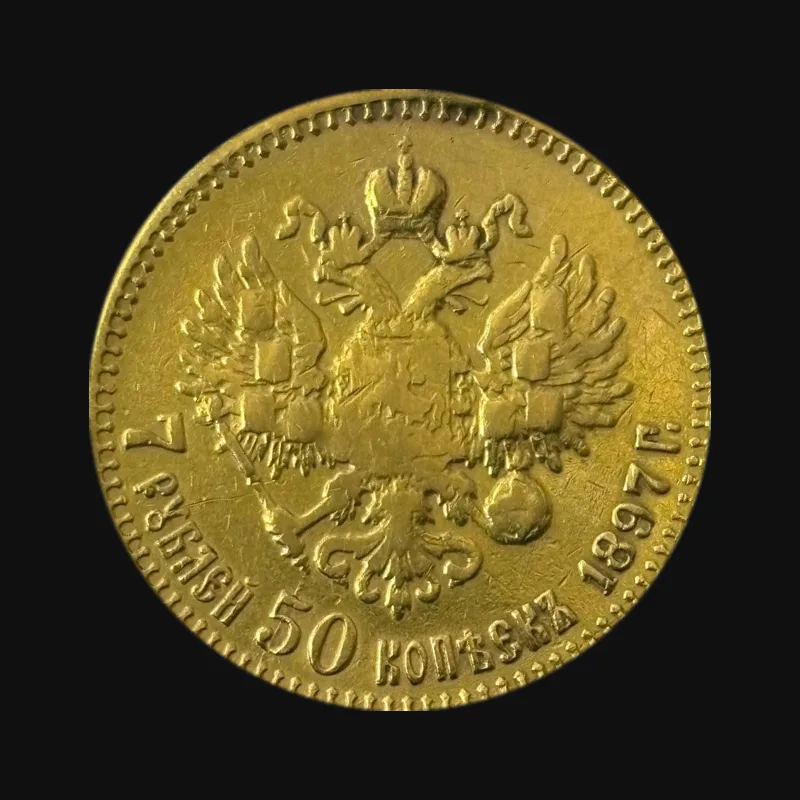
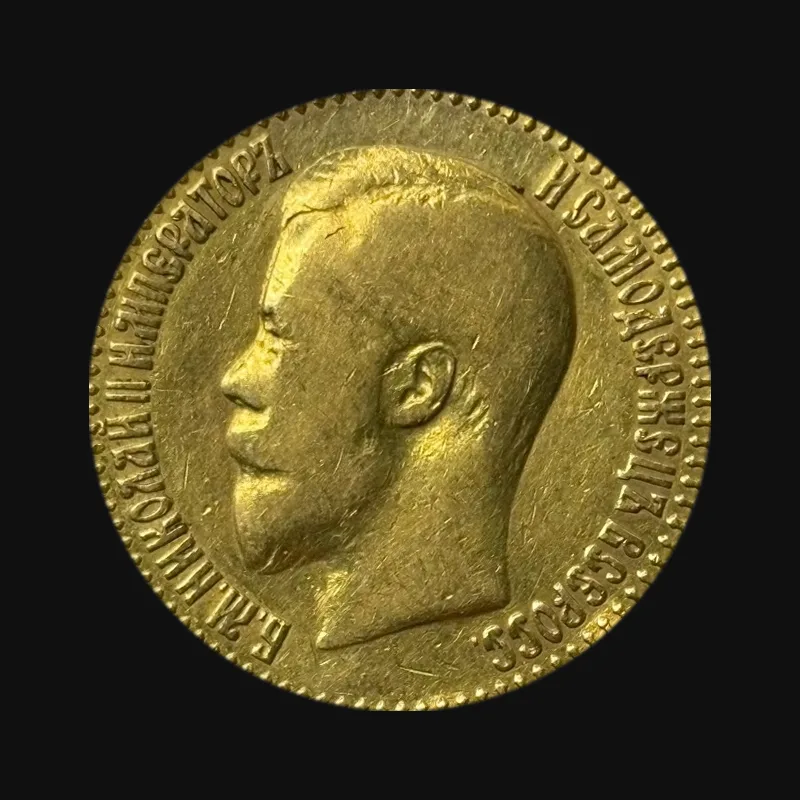
The four gold coins of the reform share the same portrait and the same eagle. The only reliable way to tell them apart is to read the line beneath the eagle. You do not need to know Cyrillic: just pick out the figures and one word.
- ‘10 РУБЛЕЙ’: ten roubles, the most common coin.
- ‘7 РУБЛЕЙ 50 КОПѢЕКЪ’: the only one to carry the word kopecks, always dated 1897.
- ‘15 РУБЛЕЙ’: the widest, also limited to 1897.
- ‘5 РУБЛЕЙ’: the smallest, 18.5 mm.
The dimensions confirm the reading. Lay the coin on a gold 20 francs: a 7.50 roubles covers it almost exactly, a 10 roubles overlaps by just under a millimetre on each side. On an accurate kitchen scale, allow 8.60 g for the 10 roubles and 6.45 g for the 7.50. A difference of more than a few hundredths of a gram on a coin with little wear should put you on your guard.
1897, the year Russian gold changed its name
To tie the rouble to gold, Finance Minister Sergei Witte had a simple rule adopted in January 1897: the new rouble would represent only two thirds of the old gold rouble, i.e. 0.774 g of fine gold. The coins in circulation, the imperial and half imperial, kept their weight and design. They were simply given a new denomination: 15 roubles and 7 roubles 50 kopecks.
These awkward figures did not last. By the end of 1897 a 5 roubles had been introduced, and a decree of December 1898 created the 10 roubles with 7.74 g of fine gold. That is why the 7.50 and 15 roubles carry only one date, whereas the 10 roubles begins in 1898.
The St Petersburg Mint then struck very large quantities until 1904, and far fewer afterwards. Gold striking ended in 1911. With the war of 1914, the rouble could no longer be exchanged for gold, and the coins left purses for safes.
The two letters on the edge
Turn the coin slowly under a lamp. The edge inscription ends with two Cyrillic letters, the initials of the mint master in office that year. They must match the date:
- АГ (Apollon Grasgof): 1897 to 1899;
- ФЗ: 1899 to 1901;
- АР: 1901 to at least 1906;
- ЭБ (Elikum Babayants): in 1899, then from 1909 to 1911.
A year paired with initials that never appeared on it is a sign of forgery. On coins mounted as jewellery the edge has often suffered: soldering, filing, a removed loop. If the initials are gone, the date on the reverse is still legible, but the coin loses part of its interest for a collector.
To judge condition, look at the Tsar’s beard and the lock above his ear, then the feathers and small shields of the eagle. These are the first areas of relief to flatten. Gold is never cleaned; our French guide to toning and stains explains why.
Copies, later strikes and neighbouring coins
The 1897 imperial. A coin marked 10 roubles and dated 1897 that weighs 12.90 g does not belong to the reform: it is an imperial of the old system, struck in very small numbers. Do not confuse it with the 15 roubles, which has the same weight.
Soviet strikes. Auction catalogues report 10 roubles struck in 1925 and 1926 with old dies, notably dated 1911. They are very hard to tell from the originals, and sources remain scarce.
The sower chervonets. This Soviet 10 roubles shows a peasant sowing grain, not a portrait: impossible to mistake once you look at the obverse.
Imitations. The 10 roubles has been widely copied. Be wary of soft relief, a grainy field, blurred letters or an irregular edge inscription. A correct weight alone is not reassuring: check the diameter too.
The other foreign gold coins found in estates are grouped in our French sections on gold coins and foreign coins.